REVIEW · REYKJAVIK
Reykjavík E-Scooter Adventure Small Group City Tour
Book on Viator →Operated by Reykjavík Rollers · Bookable on Viator
Two hours, zero lines, full Reykjavík energy. This small-group ride keeps it capped at eight and hits the big sights efficiently, with helmet training plus a safety briefing so you feel steady before you roll. I like that it’s not just sightseeing. You also get real stories as you glide past key landmarks, from Harpa’s glass facade to Hallgrímskirkja’s viewpoint. The main drawback to plan around is weather: if conditions aren’t good, the tour may be rescheduled or refunded, and you’ll want to expect wind and cold.
You’ll meet guide Viktor at Skólavörðustígur 6b, grab your mobile ticket, and get set up close to public transportation. The best part for first-timers is that you don’t need a driver’s license to join, and that the group focuses on comfort and control instead of speed. Then you’ll cruise a tight downtown loop and come back to the start point.
In This Review
- Key things I’d watch for
- Why an e-Scooter is the fastest way to orient yourself in Reykjavík
- Meet Viktor at Skólavörðustígur: gear, safety briefing, and real practice time
- Skólavörðustígur to Nauthólsvík: black sand and geothermal warm water
- Öskjuhlíð Hill glide and Höfði House’s 1986 summit spotlight
- Sun Voyager to Harpa: Viking-inspired sculpture and basalt-like glass
- Parliament, Tjörnin, and Hljómskálagarður: democracy and quiet water in one route
- Hallgrímskirkja Church and the observation deck view
- Price and value: what $51 buys you (and what it replaces)
- Weather reality check: cold wind, clothing, and first-ride nerves
- Who this tour suits best (and who might want another plan)
- Should you book the Reykjavík E-Scooter Adventure?
Key things I’d watch for

- Eight riders max for real guidance and less chaos at crossings
- Training session first, so even nervous first-time riders can catch on
- A highlight loop from the Harpa area to Parliament and on to Hallgrímskirkja
- Höfði House summit stories and photo-worthy stops like Sun Voyager
- Wind-proof planning matters, and you’ll likely want face and hand coverage
Why an e-Scooter is the fastest way to orient yourself in Reykjavík
If you’re trying to understand Reykjavík in a short visit, this tour does a smart thing: it connects the dots fast. Instead of spending hours walking between landmarks, you cover far more ground in about two hours while still getting close-up views. It’s also a good move if you hate the slow shuffle around the same crowd magnets.
The ride is built around major sights you’ll see again later as you plan the rest of your trip. Harpa Concert Hall, Sun Voyager, Parliament, and Hallgrímskirkja aren’t random picks. They’re the kind of places that help you understand the city’s layout—waterfront angles, hill views, and how Reykjavík’s culture and democracy show up in the same compact area.
One more plus: this format tends to reduce the time you’d normally waste. You’re not queueing for transport, and you’re not stuck waiting for a bus to make its way across town. You’re just moving, stopping, listening, and rolling onward.
You can also read our reviews of more tours and experiences in Reykjavik.



Meet Viktor at Skólavörðustígur: gear, safety briefing, and real practice time
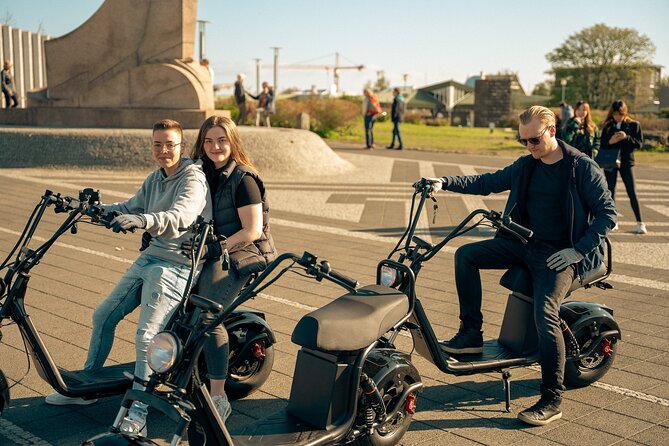
The tour starts right in the heart of downtown at Skólavörðustígur 6b. This street is known for shops and cafés, so it’s a convenient place to begin. You’ll confirm and check in with your mobile ticket, then get a safety briefing that’s meant for people with zero scooter time as well as those who’ve ridden before.
You’ll be given a helmet and guided through how to ride your modern e-scooter. The training session matters because Reykjavík streets can feel busy with pedestrians, bikes, and people who are just crossing wherever they land. The guide’s job isn’t just rules on paper. It’s helping you build confidence quickly with slow, clear instruction before you head into the sightseeing portion.
A big practical detail: even without a driver’s license, you can join. That lowers the stress for many visitors who want an easy, low-commitment way to get around. In the real world, it also means you’ll likely be sharing the start area with other first-timers—and the guide plans around that.
From the reviews, one pattern pops up: scooters are described as stable and forgiving, but the first few minutes can still feel a bit scary. So give yourself permission to take those early minutes seriously. Once you’re smooth around pedestrians and you know how to handle small turns, the fun kicks in.
Skólavörðustígur to Nauthólsvík: black sand and geothermal warm water

Your first stop is Skólavörðustígur, the classic start point for exploring Reykjavík’s downtown on foot. Even if you’ve only got a little time, the street’s charm helps you shift into vacation mode fast—shops, cafés, and that slightly storybook feel.
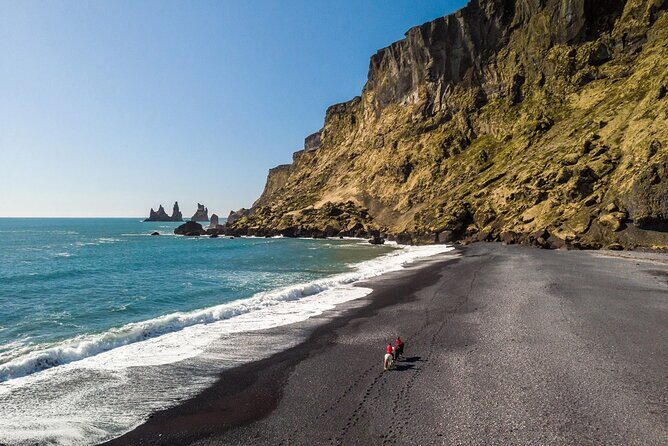
After orientation, you glide toward the coast and make your way to Nauthólsvík Beach. This is where Reykjavík surprises people. The beach is famous for black sand and geothermal-heated seawater, which makes it feel like a rare combo of rugged Iceland and a place you can actually relax.
What you’ll like here is the contrast. You’ll be riding outdoors in wind and cold, then seeing a shoreline where the water is warmed enough that it stands out from the usual icy expectations. If the weather is cooperating, it’s also a great place to pause for photos without feeling like you’re fighting for space.
The only thing to keep in mind is how long you can enjoy the stop. In strong wind, lingering on the beach may feel brisk. If that happens, enjoy the quick moment, grab your photos, and let the rest of the loop carry you.
Öskjuhlíð Hill glide and Höfði House’s 1986 summit spotlight
As you continue, you pass by Öskjuhlíð Hill, a section that feels calmer the moment you move away from the densest downtown streets. You get a fresh-air ride through the surrounding area with views that work well for both photos and a mental reset. It’s not about rushing past. It’s about feeling the city breathe.
Then you ride toward Höfði House, a historic building with major global news attached. It hosted the 1986 Reykjavík Summit between Ronald Reagan and Mikhail Gorbachev. The point of this stop isn’t to turn the tour into a lecture. It’s to show how Reykjavík’s role in world events connects to places you can actually see in a short ride.
You’ll learn what the summit meant for promoting peace and hear the more human stories that get lost when you only read a quick headline. Even if you don’t memorize every detail, you’ll walk away with a clearer sense of why certain sites are treated with respect in this city.
One practical note: expect this to be a pass-by and story-stop, not a long interior visit. The value here is in the guide’s context while you’re moving through the neighborhood.
Sun Voyager to Harpa: Viking-inspired sculpture and basalt-like glass
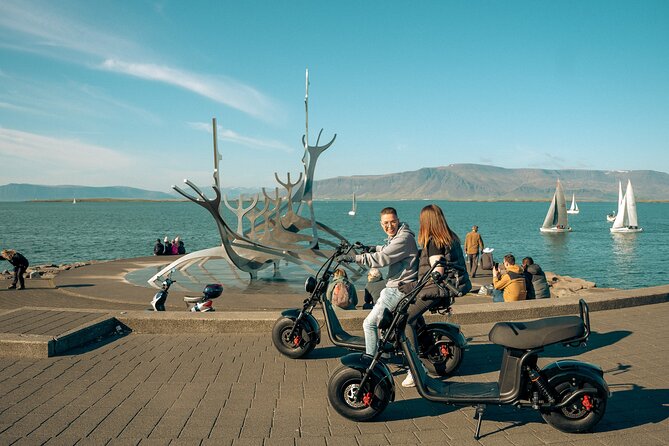
Next up is Sun Voyager, the sculpture inspired by Viking ship forms. This is one of those places where the art helps you understand Reykjavík’s relationship with the ocean. As you take it in, you also get panoramic views—ocean in one direction and Mount Esja in the distance when visibility allows.
Even if you’ve seen photos online, it lands differently in person. The sculpture is a strong silhouette against the sky, and the viewpoint helps you see how the city faces outward. It’s a stop that feels like a breath after the city-street parts.
From there, you head to Harpa Concert Hall, famous for its striking glass facade. The design is meant to echo Iceland’s basalt landscapes, which is a cool link between local geology and modern architecture. The guide also explains what goes on inside—cultural events, performances, and how Harpa fits into Reykjavík’s identity.
What I like about adding Harpa to an e-scooter loop is that you don’t have to choose between “old-world church vibes” and “modern city design.” You get both in a single ride, and you can decide later what to revisit on foot.
If conditions are windy, hold onto your phone and listen closely while moving between viewpoints. This is one stop where it helps to be ready to pause quickly for photos without rushing.






Parliament, Tjörnin, and Hljómskálagarður: democracy and quiet water in one route

After Harpa, you ride toward Parliament House, where Iceland’s democratic process unfolds. This section is more than architecture spotting. The guide gives the context so you understand why the building matters, not just what it looks like.
You may also catch a glimpse of Parliament in action, depending on timing. Even when nothing is happening visibly, you still get a better sense of how democracy is part of everyday city geography.
Then you continue to Tjörnin, a serene lake surrounded by parkland. Tjörnin’s value is how calm it feels compared to the motion of the earlier segments. The guide points out its role in Reykjavík’s urban landscape and birdlife, which helps you notice things you’d miss if you were just passing through without stopping.
After the lake, you move to Hljómskálagarður, a tranquil park setting that’s perfect for a brief reset. The park portion is where the tour rhythm slows a touch, and that matters on a cold day. You get a place to stand, breathe, and feel less like you’re constantly in motion.
Hallgrímskirkja Church and the observation deck view
Your tour wraps by heading toward Hallgrímskirkja Church, the towering landmark that dominates the Reykjavík skyline. This is the kind of stop where you feel the city’s scale the moment you approach it. It’s not subtle, and that’s part of the point.
You’ll ascend to the observation deck for panoramic views over Reykjavík. This is where you start to “map” the city in your mind. You see how water, streets, and hills relate to each other, and suddenly the earlier stops make even more sense.
You’ll also hear stories about the church’s construction and its role in Icelandic culture. That context helps you appreciate why locals treat the building as more than just an impressive silhouette.
If you’re sensitive to stairs or heights, keep in mind there’s an ascent for the view. The tour still isn’t described as physically demanding, but this final push is the one part that’s more step-based than ride-based.
Price and value: what $51 buys you (and what it replaces)
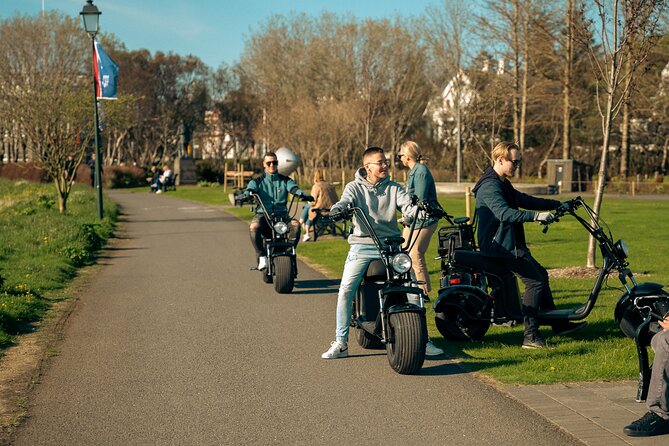
At $51 for an approximately two-hour experience, the big value isn’t only the scooter. It’s the whole package of guided pacing, gear, and context.
You’re paying for:
- A modern scooter you don’t have to rent or manage
- A helmet plus a real training session
- A guide who shares stories while you’re moving between stops
For many visitors, this replaces two things: time spent figuring out transport and time spent building a sensible route across downtown. Instead, you get a structured overview that helps you decide what to return to after the ride.
The small-group cap of eight is also a value driver. It means you’re not stuck in a long line of people slowing down the group at every stop. You tend to get clearer instructions and more attention if you’re still learning the scooter rhythm.
Weather reality check: cold wind, clothing, and first-ride nerves
This tour requires good weather, which is important to know up front. Reykjavík weather can change fast, and a scooter ride turns “a little chilly” into “stand-still cold” if the wind picks up.
For what to do with that: dress for wind. Your face and hands feel the cold first. One tip echoed in the feedback: cover your lower face, because the breeze can be relentless.
If you’re worried about staying dry, there’s encouraging news from a review stating the team provided good clothes when weather was not nice, and the rider stayed dry. You should still assume you’ll need warm layers, but it helps to know they don’t just shrug if conditions turn.
Finally, if you’ve never ridden an e-scooter, plan for a slightly wobbly start. That’s normal. The training session is exactly for this. After a short practice period, most people settle quickly and start enjoying the glide.
Who this tour suits best (and who might want another plan)
This is a strong choice if you want an efficient overview of Reykjavík. It’s especially good for first-timers who want to see major landmarks without turning the trip into a walking contest. The tour is also described as not too physically taxing, which makes it appealing for people who still want a fun, active way to get around.
It’s also a smart move if you like history and architecture, but you don’t want to read a book for every stop. You’ll get context while you’re at the landmarks: the summit story at Höfði House, the design ideas behind Harpa, and the cultural importance of Hallgrímskirkja.
You might think twice if you strongly dislike mixing with pedestrian traffic or you’re worried about balancing on a scooter, even after practice. And if your trip is built around a very inflexible schedule on a day with uncertain weather, keep in mind the tour depends on conditions.
Should you book the Reykjavík E-Scooter Adventure?
Yes, if you want to get your bearings fast and see a well-chosen set of Reykjavík highlights without spending the whole day walking. I also like booking this early in the trip. Once you’ve ridden the main loop and understood the geography, it’s easier to pick neighborhoods and returns later—especially places you might want to revisit at a slower pace.
Book it with eyes open: dress for cold wind, expect a short learning curve, and treat the training as part of the experience, not an annoyance. If you do that, you’ll likely come away with a clear mental map of the city and a fun memory that feels different from the usual bus-and-photos routine.